
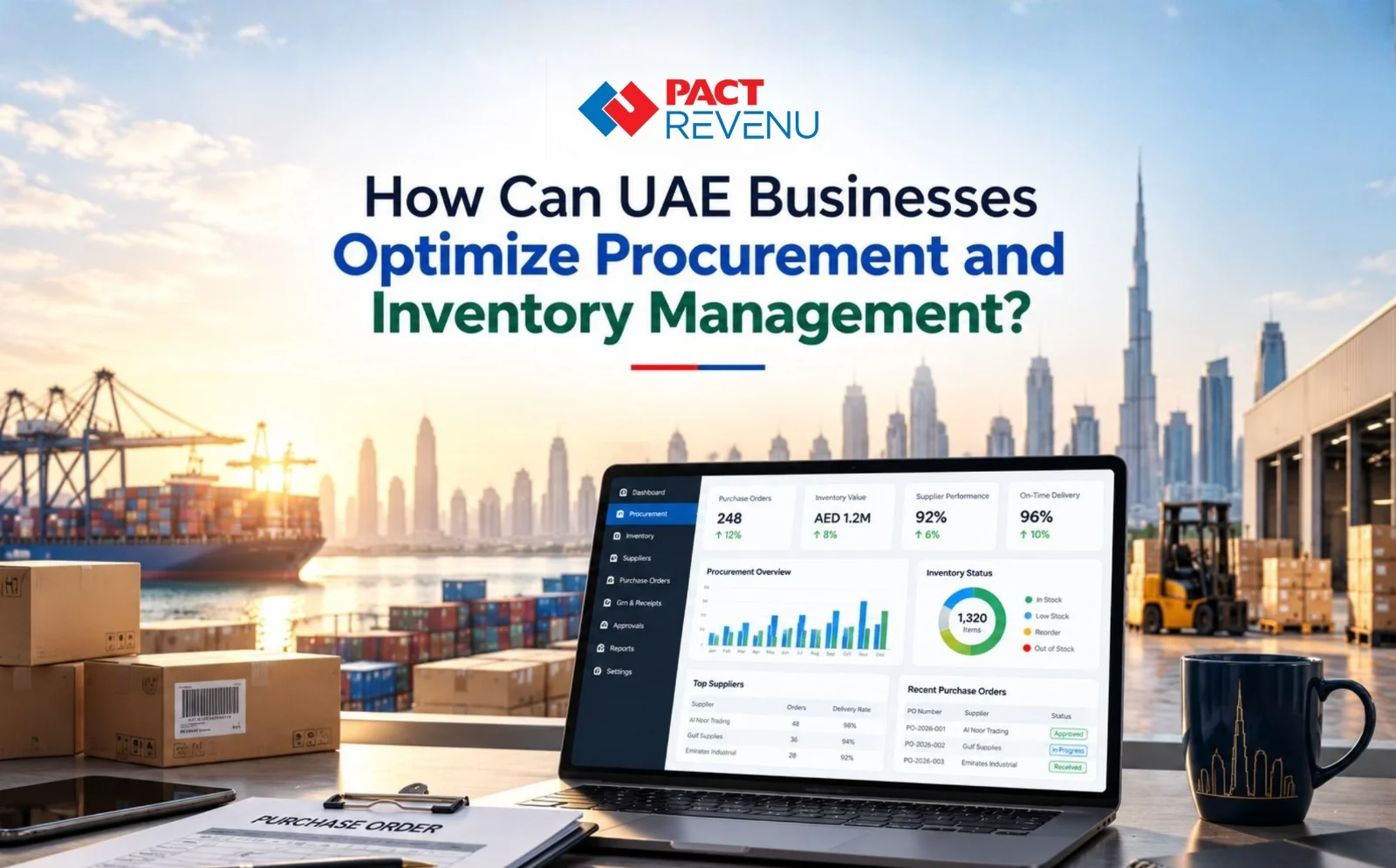
How Can UAE Businesses Optimize Procurement and Inventory Management?
UAE businesses can optimize procurement and inventory management by planning purchases around demand, evaluating suppliers carefully, standardizing approval workflows and maintaining accurate stock records. Strategic procurement and supply chain management help connect purchasing, inventory, finance and operations, giving decision-makers better visibility into stock requirements, supplier performance, purchasing costs and potential supply disruptions.
Why Are Procurement and Inventory Management Important for UAE Businesses?
Procurement and inventory management influence how effectively a business purchases materials, controls stock and fulfils customer requirements. When these processes operate separately, businesses may face unnecessary purchases, delayed orders, inaccurate stock records and avoidable pressure on working capital.
For UAE businesses, these challenges can become more complex when operations involve multiple locations, imported materials, changing customer demand, or suppliers with different delivery schedules.
Consider a wholesale distributor serving customers in Dubai, Abu Dhabi and other emirates. If each warehouse maintains separate stock records and purchasing decisions are made without a shared view of inventory, one location may order products that another already has in excess. The result can be duplicated purchasing and uneven stock availability.
Strategic procurement and supply chain management help businesses coordinate these activities through consistent planning, supplier evaluation, inventory monitoring and communication between departments.
Common procurement and inventory challenges
Businesses may encounter several operational problems:
- Overstocking: Excess inventory ties up working capital and increases storage, handling and potential obsolescence costs.
- Stock shortages: Insufficient stock can delay orders, interrupt production, or affect customer service.
- Delayed purchasing: Late approvals or unclear responsibilities can prevent essential materials from arriving on time.
- Inaccurate inventory records: Differences between recorded and actual stock can lead to incorrect purchasing decisions.
- Disconnected departments: Procurement, warehouse, finance and operations teams may work with different information.
- Supplier dependency: Relying heavily on one supplier can increase exposure to delays, price changes and availability problems.
Addressing these issues requires more than negotiating lower prices. Businesses need a structured process that connects purchasing decisions with actual demand, available inventory, budgets and delivery requirements.
How Can Strategic Procurement and Supply Chain Management Improve Business Operations?
Strategic procurement and supply chain management involve planning what to purchase, selecting suitable suppliers, controlling purchasing decisions and coordinating the movement of goods from suppliers to the business.
Rather than treating every purchase as a separate transaction, businesses use consistent policies and relevant operational information to make informed decisions.
1. Plan purchases around actual demand
Purchase planning should consider sales trends, confirmed customer orders, production schedules, current stock and expected supplier lead times.
For example, a UAE retailer preparing for a seasonal sales period may need to increase selected product orders while avoiding unnecessary purchases of slower-moving items. Reviewing previous sales alongside current demand can help the purchasing team prepare a more suitable replenishment plan.
Useful planning practices include:
- Reviewing historical sales and seasonal demand.
- Checking available, reserved and incoming stock.
- Identifying products with long replenishment lead times.
- Coordinating purchasing with sales and operations forecasts.
- Reviewing minimum stock levels and safety stock requirements.
Forecasts should be updated when demand changes. Historical sales alone may not accurately predict demand during promotions, market disruptions, or unusual seasonal conditions.
2. Evaluate suppliers beyond price
The lowest quoted price does not always represent the best purchasing decision. A supplier’s reliability, product quality, delivery consistency, payment terms and ability to meet business requirements also matter.
UAE businesses sourcing imported products or materials should consider transportation arrangements, expected delivery times, documentation requirements and potential supply interruptions.
A supplier evaluation process can include:
- Total purchase cost, including relevant freight and handling expenses.
- Product quality and consistency.
- Delivery reliability and lead times.
- Payment terms and commercial conditions.
- Responsiveness when orders or specifications change.
- Availability of alternative suppliers for critical items.
Maintaining updated supplier records makes it easier to compare quotations, review previous orders and identify recurring delivery issues.
3. Standardize purchase approvals
A clear approval workflow helps businesses ensure that purchases are reviewed by the appropriate people before orders are placed.
For example, a construction company may require project managers to confirm material requirements, procurement staff to compare supplier quotations and authorized managers to approve purchases according to internal spending limits.
Effective procurement operations management can establish:
- Defined purchasing responsibilities.
- Approval limits based on company policy.
- Consistent purchase request and purchase order procedures.
- Documentation for quotation comparisons and order changes.
- Clear communication between procurement and finance.
These controls can reduce confusion and improve purchasing visibility. However, approval rules should remain practical. Excessively complicated approval processes can delay urgent purchases and disrupt operations.
4. Coordinate purchasing with inventory replenishment
Procurement decisions should reflect stock availability rather than relying only on individual department requests.
Reorder points can help businesses identify when replenishment may be necessary. A basic reorder point considers expected demand during supplier lead time and an appropriate safety stock allowance.
For example:
Reorder point = Expected demand during lead time + Safety stock
A business should adjust this calculation to account for demand variability, supplier reliability, stock already on order and its service requirements.
Regular inventory reviews can also identify slow moving products, excess materials and items approaching expiry or obsolescence. These findings help purchasing teams decide whether to reorder, delay a purchase, transfer stock between locations, or review demand assumptions.
How Can Businesses Improve Inventory Visibility and Cost Control?
Inventory visibility means having reliable information about what is available, where it is stored, what has been allocated and what is expected to arrive. This information helps purchasing teams make decisions based on operational requirements rather than assumptions.
For UAE businesses operating across warehouses, branches, project sites, or distribution centres, maintaining consistent inventory records is particularly important.
Monitor stock across locations
Businesses should establish a standard method for recording stock receipts, issues, transfers, returns and adjustments. Where multiple locations are involved, the process should make it possible to distinguish physical stock at each location from stock that is reserved or already committed to customers.
Regular cycle counts and periodic physical stock checks can help identify differences between system records and actual quantities.
Use inventory data to control purchasing costs
Inventory cost control is not simply about reducing the quantity of stock held. Businesses must also consider the consequences of running out of essential products or materials.
A practical approach includes:
- Identifying fast moving, slow moving and non moving items.
- Setting reorder levels according to demand and replenishment time.
- Reviewing excess stock before creating new purchase orders.
- Monitoring supplier price changes and purchase commitments.
- Comparing forecast demand with actual consumption.
- Reviewing stock discrepancies and their causes.
For example, a manufacturing business in the UAE may need to maintain sufficient raw materials to avoid production interruptions. Reducing every stock category to the lowest possible level could increase the risk of delays if imported materials take longer than expected to arrive.
The appropriate inventory policy should therefore balance availability, storage costs, cash flow and operational risk.
What Role Does Procurement Software Play in Supply Chain Management?
A suitable procurement management solution can help businesses organize purchasing information, standardize workflows and make relevant records easier to access. Its value depends on the features available, the quality of the underlying data and how well the system fits existing business processes.
Manual processes versus software supported workflows
| Business activity | Manual or disconnected processes | Software supported processes |
| Purchase requests | Requests may arrive through different channels | Requests can follow a defined workflow if supported |
| Purchase approvals | Email follow ups and separate records | Approval status can be tracked centrally if available |
| Supplier management | Information may be spread across files | Supplier records can be organized in one system if supported |
| Inventory monitoring | Updates may be delayed or inconsistent | Stock information can be easier to review when records are integrated |
| Cost control | Reports require manual consolidation | Purchasing and inventory reports can support regular reviews |
| Financial reconciliation | Purchase and invoice details may need manual comparison | Integrated workflows can help connect relevant records |
Connect procurement, inventory and accounting
When business systems are disconnected, employees may need to enter the same information into multiple applications. This can create duplicate work, inconsistent records and delays in reporting.
Integrated business software can help connect purchasing transactions with inventory records, supplier invoices, accounting entries and management reports, depending on the available integrations and configuration.
For example, when goods are received, an appropriately configured workflow may allow the relevant team to update receipt records and provide information needed for invoice verification. Finance can then compare the purchase order, goods receipt and supplier invoice before processing payment, according to company policy.
This approach can improve the visibility of outstanding purchases, expected payments, stock movements and purchasing commitments. It does not remove the need for verification or appropriate financial controls.
How should UAE businesses choose a procurement management solution?
Before selecting software, businesses should assess their operational needs rather than choosing a system based only on the number of features advertised.
Consider these factors:
- Business size and complexity: A single location business may need simpler workflows than an organization managing multiple warehouses, projects, or legal entities.
- Industry requirements: Retail, manufacturing, wholesale distribution and construction have different purchasing and stock management needs.
- Integration requirements: Check whether the system can connect with existing accounting, inventory, sales and enterprise resource planning systems.
- Reporting capabilities: Confirm whether the available reports cover supplier performance, purchase commitments, stock levels, spending and other relevant measures.
- Scalability: Consider whether the solution can accommodate additional users, products, warehouses, or business units as operations grow.
- Ease of use: Employees should be able to follow the workflows without unnecessary complexity.
- Implementation and support: Review configuration costs, training, data migration, maintenance and ongoing support.
- Data security and access: Check permissions, backup arrangements and relevant security controls.
PACT REVENU is a business software solutions provider. UAE businesses can discuss their procurement, inventory and operational management requirements with the company to determine which software options may be suitable. Specific procurement capabilities, integrations and implementation arrangements should be confirmed directly before making a purchasing decision.
How Can UAE Businesses Implement Better Procurement and Inventory Processes?
Selecting suitable software is only one part of improving procurement. Businesses also need reliable data, clearly defined procedures and employees who understand how the system supports their responsibilities.
A phased implementation can help reduce disruption.
Step 1: Review existing workflows
Document how purchase requests are raised, quotations are evaluated, orders are approved, goods are received and supplier invoices are checked.
Identify recurring delays, duplicated work, unclear responsibilities and reporting gaps before changing the process.
Step 2: Clean and standardize business data
Review supplier records, product codes, units of measurement, stock quantities, lead times and purchasing categories. Remove duplicate records where appropriate and resolve known inventory discrepancies.
Incorrect opening balances or inconsistent product information can affect every subsequent report, even when the software itself is working correctly.
Step 3: Define responsibilities and approval rules
Specify who can request, approve, order, receive and verify purchases. Establish spending limits and escalation procedures based on the business’s internal controls.
The process should also explain how urgent purchases and supplier substitutions are handled.
Step 4: Train employees and coordinate with suppliers
Provide practical training for procurement, inventory, finance and operations teams. Explain which records each team must maintain and how exceptions should be reported.
Where relevant, communicate changes to suppliers, including purchase order requirements, delivery arrangements and documentation procedures.
Step 5: Test, measure and improve
Start with a manageable product category, location, or business unit if the implementation approach allows it. Check whether transactions, stock balances, approvals and reports produce reliable results before expanding.
Track relevant measures such as:
- Purchase order approval time.
- Supplier on time delivery rate.
- Inventory record accuracy.
- Stockout frequency.
- Excess and slow moving inventory.
- Purchase price differences.
- Time required to reconcile supplier invoices.
These measures establish a baseline for reviewing progress. Results will depend on the starting conditions, business processes, supplier performance and implementation quality.
What challenges should businesses expect?
Implementation can involve upfront software and configuration costs, employee resistance, data migration issues and integration limitations. Small businesses may need to prioritize essential workflows, while larger organizations may require more extensive planning and testing.
Software cannot independently correct unrealistic forecasts, unreliable suppliers, poor purchasing policies, or inaccurate stock counts. Businesses should review their processes regularly and use operational data to identify where further improvements are needed.
Key Takeaways
- Plan purchases around demand: Use sales forecasts, current inventory, supplier lead times and operational requirements to guide purchasing decisions.
- Evaluate suppliers carefully: Consider reliability, quality, delivery schedules and total purchasing costs rather than price alone.
- Improve inventory visibility: Maintain accurate stock records and coordinate replenishment across warehouses, branches and departments.
- Standardize procurement workflows: Clear approval rules and shared information help procurement, finance, inventory and operations teams coordinate their work.
- Choose software carefully: Assess integration needs, reporting, scalability, implementation costs and employee adoption before selecting a solution.
Improve Procurement and Inventory Management with PACT REVENU
Effective procurement and inventory management require coordination between purchasing, suppliers, stock control, finance and operations. For UAE businesses, a structured approach can help improve purchasing visibility, identify inventory risks and support more informed operational decisions.
The right business software should match the organization’s processes, industry requirements and future plans. Before implementation, businesses should confirm the available features, integration options, costs and support arrangements.
Get in touch with PACT REVENU to explore business software solutions that support your procurement, inventory and operational management needs.
Frequently Asked Questions
1. What is strategic procurement and supply chain management?
Strategic procurement and supply chain management involve planning purchases, evaluating suppliers, managing inventory requirements and coordinating the movement of goods. The objective is to align purchasing decisions with business demand, budgets and operational priorities.
2. How can UAE businesses reduce inventory costs without causing stock shortages?
Businesses can review demand forecasts, supplier lead times, reorder points and safety stock levels to balance inventory availability with holding costs. Regular stock checks and monitoring of slow-moving products can also help prevent unnecessary purchases.
3. What is procurement operations management?
Procurement operations management covers the day-to-day processes involved in requesting, approving, ordering and tracking purchases. Standardized workflows help teams maintain consistent records, clarify responsibilities and coordinate purchasing activities with inventory and finance.
4. How can a procurement management solution help a business?
A suitable procurement management solution can organize purchasing records, support approval workflows and improve visibility into supplier and purchasing information, depending on its capabilities. When appropriately integrated with inventory and accounting systems, it can also support more informed replenishment and financial decisions.
5. What should UAE businesses consider before choosing procurement software?
Businesses should evaluate industry requirements, business size, supplier workflows, inventory complexity, integration needs, reporting, scalability and total implementation costs. They should also confirm data security arrangements, training requirements, support availability and the specific features included in the proposed solution.