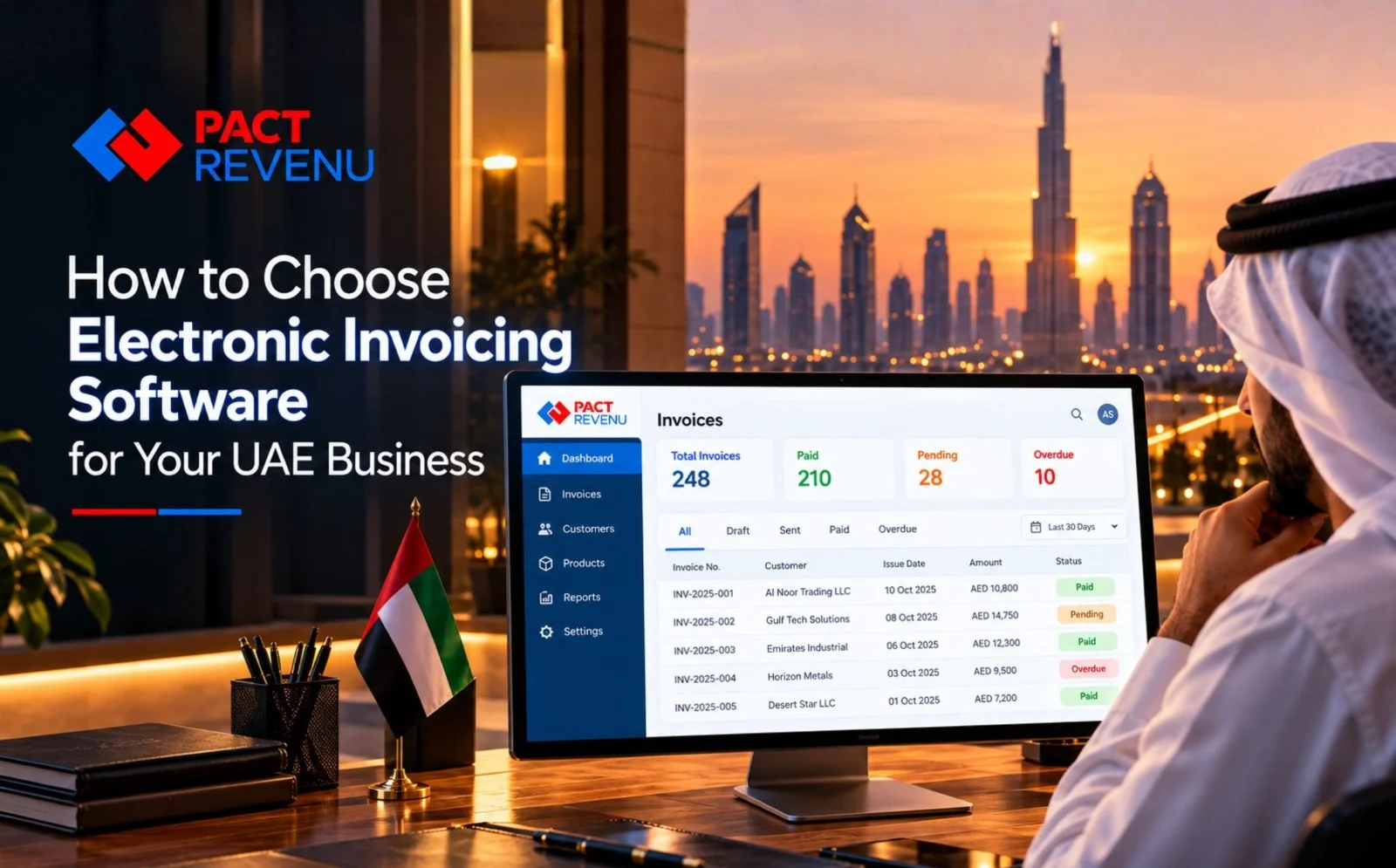
How to Choose Electronic Invoicing Software for Your UAE Business
Choosing the right electronic invoicing software helps UAE businesses manage invoices, improve billing accuracy, organize VAT records, and connect financial information with accounting workflows. Before selecting a solution, compare its invoicing features, integration options, security controls, scalability, and support. The right choice should meet your current business needs and help you prepare for applicable UAE e-invoicing requirements.
Why Do UAE Businesses Need Electronic Invoicing Software?
Electronic invoicing software allows businesses to create, process, store, and manage invoices digitally. Depending on its capabilities, the software can reduce repetitive data entry, improve recordkeeping, and help finance teams track outstanding payments.
For UAE businesses, invoicing also needs to fit existing accounting processes and applicable VAT obligations. Managing invoices manually or through disconnected spreadsheets can make it harder to maintain consistent records and identify billing errors.
A suitable electronic invoicing system can help businesses:
- Create invoices using consistent templates and customer details.
- Track issued invoices, payments, and outstanding balances.
- Organize invoice information for accounting and reporting.
- Reduce duplicate data entry between billing and finance teams.
- Maintain accessible records for internal reviews and applicable tax requirements.
However, digital invoicing alone does not automatically establish regulatory compliance. Businesses should confirm that their chosen software supports the specific requirements applicable to their operations.
What Features Should You Compare Before Choosing E Invoice Software?
Not every business needs the same invoicing features. A company issuing a limited number of invoices may prioritize simplicity, while a business with multiple branches or high transaction volumes may need automation and more advanced controls.
1. Invoice Creation and Billing Accuracy
Look for software that supports reusable invoice templates, customer records, item descriptions, pricing, discounts, and relevant tax fields. Automatic calculations can reduce manual work, but users should still be able to review invoice details before issuing them.
The system should also support the document types and credit note workflows your business requires.
2. UAE VAT Handling
Check whether the software supports the VAT workflows relevant to your business, including applicable tax rates, tax calculations, tax invoices, credit notes, and VAT reporting data.
Ask the provider how the system handles corrections, transaction records, and changes to tax settings. Have your finance team or tax adviser verify that the configuration reflects your business activities and current Federal Tax Authority requirements.
3. Accounting and Business System Integration
Your invoicing software should fit your existing financial workflow rather than create another isolated database.
Check whether it integrates with your accounting software, ERP, customer relationship management system, payment platform, or inventory tools where needed. Confirm how customer records, invoice data, payments, and tax information are synchronized.
Ask whether the integration is native, API-based, or dependent on manual imports. Clarify whether additional integration or customization charges apply.
4. Security, Access, and Audit Records
Financial information requires appropriate protection. Evaluate user permissions, authentication controls, backup arrangements, data retention, and available audit trails.
Ask where information is stored, how access is managed, and what procedures apply to data recovery and account termination. Security features should be assessed against your organization’s internal policies and applicable legal obligations.
How Do You Evaluate UAE E-Invoicing Requirements?
The UAE’s electronic invoicing programme is an important consideration when choosing a solution. Businesses should distinguish between general digital invoicing, VAT obligations, and the country’s developing e-invoicing framework.
The UAE Ministry of Finance has introduced an e-invoicing framework based on structured electronic invoice data and the use of accredited service providers. This is different from simply sending a PDF invoice by email.
As implementation progresses, businesses should verify the applicable implementation phase, relevant deadlines, scope, and technical requirements through official Ministry of Finance announcements. Federal Tax Authority guidance should also be reviewed for applicable VAT obligations.
Before purchasing software, ask the provider:
- Is the solution currently integrated with an accredited service provider, or is that integration still planned?
- What evidence confirms the provider’s current accreditation status?
- Does the solution support the required structured invoice data and transmission process for my business?
- Which implementation dates and obligations apply to my business category?
- Are updates to meet new technical requirements included in the service agreement?
Do not assume that every business is subject to the same implementation deadline or that ordinary PDF invoicing satisfies the future e-invoicing framework.
How Can You Compare Invoicing Software Providers?
Use a consistent checklist when evaluating vendors. Request a product demonstration using realistic invoice scenarios from your business rather than relying only on a feature list.
| Evaluation area | What to check |
| Invoicing features | Templates, corrections, credit notes, and payment tracking |
| VAT workflows | Relevant tax calculations, invoice fields, and reporting |
| Integration | Compatibility, synchronization, and setup costs |
| Regulatory readiness | Verified accreditation and applicable technical capabilities |
| Security | Permissions, backups, audit records, and data protection |
| Scalability | Multiple users, branches, currencies, and transaction volumes |
| Support | Training, response times, maintenance, and upgrade policies |
| Total cost | Subscription, implementation, integration, and ongoing fees |
What Should You Know About Implementation Costs?
The advertised subscription price may not represent the total cost of ownership. Ask for a breakdown covering setup, migration of existing records, custom integrations, staff training, support, and future upgrades.
Also establish who will configure tax settings, test invoice workflows, and approve the system before launch. A short pilot with representative transactions can help uncover missing features and workflow issues before the business moves fully to the new system.
How Can PACT REVENU Help UAE Businesses Evaluate Their Needs?
PACT REVENU provides business software solutions for organizations evaluating ways to manage their financial and operational workflows. Businesses considering electronic invoicing can assess their requirements around billing processes, accounting integration, VAT-related workflows, and future system needs before choosing an appropriate solution.
The right approach starts with understanding how your business currently creates invoices, manages payments, maintains financial records, and exchanges data with other systems.
Before making a decision, discuss your transaction volume, existing accounting software, number of users, reporting requirements, and expected implementation timeline with the provider. Confirm the specific product capabilities, integration arrangements, and regulatory readiness that are available for your proposed setup.
PACT REVENU’s relevant product capabilities and UAE e-invoicing readiness should be confirmed before making specific product or compliance claims.
Key Takeaways
- Choose electronic invoicing software that fits your current billing and accounting workflows.
- Verify VAT-related functionality against the requirements applicable to your business.
- Check integrations, security controls, scalability, training, and ongoing support.
- Confirm current UAE e-invoicing implementation requirements and provider accreditation through official sources.
- Compare the full implementation and ownership costs before making a commitment.
Choose the Right Electronic Invoicing Solution for Your UAE Business
The right electronic invoicing software should make everyday billing easier while supporting accurate financial records and your business’s evolving requirements.
Get in touch with PACT REVENU to discuss your business’s electronic invoicing requirements. Review your existing workflows, integration needs, and future plans to identify a suitable approach for your organization.
Frequently Asked Questions
1. What is electronic invoicing software?
Electronic invoicing software helps businesses create, issue, manage, and store invoices digitally. Depending on its capabilities, it can also support payment tracking, accounting integration, and structured electronic invoice processing.
2. Is electronic invoicing mandatory for all UAE businesses?
The UAE is implementing an electronic invoicing framework in phases, and the applicable scope and deadlines depend on official requirements. Businesses should verify their obligations and implementation timeline with the UAE Ministry of Finance and relevant Federal Tax Authority guidance.
3. Does e invoice software need to support UAE VAT?
Businesses subject to UAE VAT should ensure that their invoicing workflows support the applicable tax invoice, credit note, and recordkeeping requirements. Confirm the software configuration with your finance team or tax adviser.
4. Can electronic invoicing software integrate with accounting systems?
Yes, many solutions offer accounting integrations through built-in connections, APIs, or data imports. Check which systems are supported, what information is synchronized, and whether additional setup fees apply.
5. How much does electronic invoicing software cost in the UAE?
Pricing varies according to features, users, invoice volumes, integrations, implementation, and support arrangements. Request a detailed quotation that includes both initial setup costs and ongoing charges before selecting a provider.