
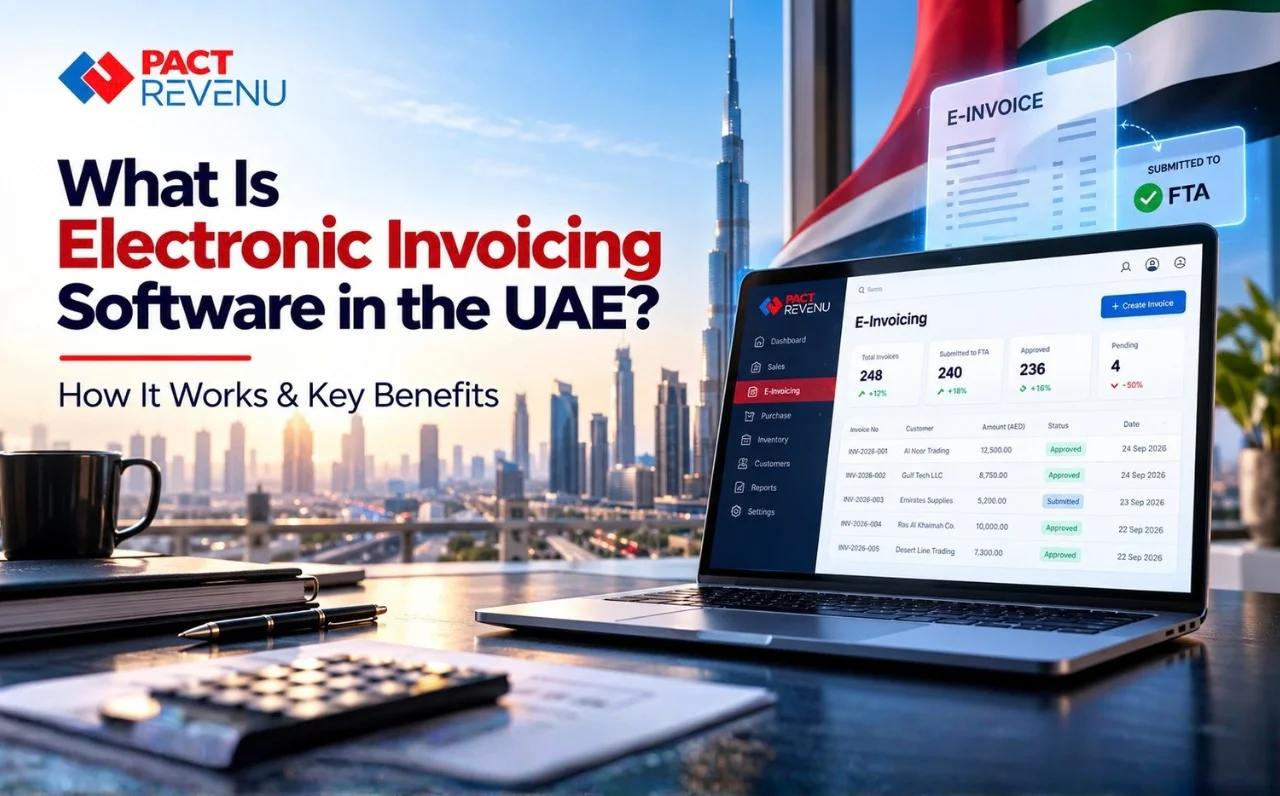
What Is Electronic Invoicing Software in the UAE? How It Works & Key Benefits
For many UAE businesses, invoicing still involves spreadsheets, PDFs, emails, manual data entry, and repeated follow-ups. As invoice volumes grow, these processes can make it harder to identify errors, track outstanding amounts, and maintain consistent financial records.
Electronic invoicing software provides a more structured way to create, process, exchange, track, and manage invoice data digitally. In the UAE, this topic has become particularly important as the Ministry of Finance and Federal Tax Authority continue implementing the national eInvoicing framework.
Understanding how an electronic invoicing system works can help UAE businesses prepare their accounting processes, data, systems, and finance teams before their applicable implementation date.
What Is Electronic Invoicing Software?
Electronic invoicing software is a digital system that helps businesses create, process, exchange, manage, and store structured invoice data electronically. Unlike a simple PDF invoice, a UAE eInvoice is structured invoice data that can be electronically exchanged between a supplier and buyer and reported to the Federal Tax Authority through the applicable framework.
This distinction matters. A PDF, scanned document, image, Word file, or invoice sent only as an email attachment is not considered an eInvoice under the UAE framework.
An e invoicing software solution can bring several finance activities together, including:
- Creating invoices from business transactions
- Checking invoice and tax information
- Sending or exchanging invoice data electronically
- Tracking invoice status
- Connecting invoices with accounting records
- Maintaining digital records
- Supporting reporting and reconciliation
For finance teams, the main advantage is having structured invoice information connected to the wider financial workflow rather than treating every invoice as a separate document.
How Does an E Invoice System Work in the UAE?
The exact technical workflow depends on the software, service provider, and applicable UAE framework. At a general level, an electronic invoice moves through several connected stages.
1. Create the invoice
The business generates an invoice from its ERP, accounting, billing, or other business system. Customer, supplier, transaction, and relevant VAT information should be accurate.
2. Validate invoice information
The system can check required information before the invoice moves forward. Validation helps identify missing or inconsistent data that could otherwise create processing problems.
3. Submit or exchange the invoice data
Under the UAE framework, electronic invoices are exchanged through the applicable electronic invoicing infrastructure and Accredited Service Providers (ASPs). The UAE model uses structured invoice data and the Peppol framework.
4. Deliver the invoice to the customer
After the relevant validation and exchange steps, the invoice is made available to the buyer through the agreed electronic channel.
5. Record and reconcile the transaction
Invoice information can remain connected with accounts receivable, accounting, VAT records, payments, and reconciliation processes where the system supports those integrations.
6. Store invoice information
Digital records can be retained within the relevant business systems, making it easier for authorized finance teams to retrieve information for reporting, reconciliation, and audit-related work.
The UAE’s official framework describes a more specific multi-corner architecture involving the supplier, supplier-side ASP, Peppol network, buyer-side ASP, buyer, and reporting to the FTA.
Electronic Invoicing in the UAE: What Businesses Should Know
The UAE Ministry of Finance has established a national eInvoicing framework, and the Federal Tax Authority provides official information on the programme and related legislation. The Ministry states that the official eInvoicing portal is the primary source for information about the UAE programme.
The rollout is phased rather than a single implementation date for every business.
As of September 2026, the official guidance states that voluntary electronic invoicing can begin from 1 July 2026. Mandatory implementation is being phased according to revenue and entity type. For businesses with annual revenue of AED 50 million or more, the deadline to appoint an Accredited Service Provider has been extended to 30 October 2026, while implementation remains scheduled for 1 January 2027. Businesses with annual revenue below AED 50 million have an ASP appointment deadline of 31 March 2027 and an implementation date of 1 July 2027.
Because the framework can be updated, businesses should verify their specific obligations directly through the UAE Ministry of Finance and Federal Tax Authority before making implementation decisions.
What should UAE businesses prepare?
Before implementation, finance teams should review:
- Customer and supplier master data
- UAE VAT and tax information
- Invoice fields and transaction data
- Accounting or ERP capabilities
- Required system integrations
- Existing invoice records
- Approval and finance workflows
- Digital record management
- Testing and error-handling processes
- Internal responsibilities for eInvoicing
The Ministry’s readiness guidance also recommends understanding the requirements, reviewing accounting/ERP/invoicing systems, selecting an ASP, testing invoice exchange and reporting, and establishing processes for going live and managing future changes.
Key Benefits of Using Electronic Invoicing Software
Faster Invoice Processing
Automated invoice creation can reduce repetitive data entry. Instead of preparing every invoice manually, businesses can generate invoice information from existing transactions and workflows where supported.
For a finance team handling hundreds of invoices each month, even small reductions in repetitive work can make daily processing easier.
Fewer Manual Errors
Manual copying of customer information, quantities, prices, tax values, and invoice details can introduce avoidable mistakes.
Electronic invoicing software can use standardized information, automated calculations, and validation checks to reduce some of these errors. It does not eliminate the need for proper data management and human review.
Better Invoice Tracking
A centralized system can give finance teams clearer visibility into invoice status, outstanding balances, approvals, and payment progress.
This is particularly useful when several employees manage invoices across different customers or business units.
Improved Cash Flow Visibility
Better invoice processing and receivables visibility can help businesses understand what has been invoiced, what remains outstanding, and which transactions require attention.
However, software does not guarantee that customers will pay faster. Payment timing still depends on customer terms, approval processes, disputes, and other commercial factors.
Easier Record Management
Searching through email attachments and folders can become difficult as invoice volumes increase.
Digital records can make it easier for authorized users to retrieve invoice information, review transactions, prepare reports, and support audit or reconciliation activities.
Better Integration
Modern e invoicing solutions can connect invoicing with accounting, ERP, inventory, CRM, payment, and financial systems where supported.
This reduces the need to enter the same transaction information repeatedly across disconnected systems.
Scalable Finance Operations
A manual process that works for 50 invoices may become difficult to manage at 500 or 5,000 invoices.
Automation allows businesses to build more consistent processes as transaction volumes, customers, suppliers, and business entities grow.
Electronic Invoicing Software vs Traditional Invoicing
| Factor | Traditional/Manual Invoicing | Electronic Invoicing |
| Invoice creation | Manual | Digital/automated |
| Data entry | Repetitive | Reduced through automation |
| Tracking | Often manual | Centralized visibility |
| Error risk | Higher with manual entry | Can be reduced through validation |
| Record retrieval | Time-consuming | Faster digital search |
| Integration | Often limited | Can integrate with business systems |
| Scalability | More manual effort as volume grows | Better suited to higher transaction volumes |
The right approach depends on the size, systems, processes, and regulatory obligations of each business. Electronic invoicing should be viewed as part of a broader finance workflow rather than simply replacing paper with digital documents.
What Features Should You Look for in E Invoicing Solutions?
When comparing solutions, UAE businesses should look beyond basic invoice generation.
Look for capabilities such as:
- UAE VAT support
- Structured electronic invoice capabilities
- Invoice customization
- Automated invoice generation
- Invoice validation
- Customer and supplier management
- Accounts receivable tracking
- Accounting and ERP integration
- Secure digital records
- Reporting and dashboards
- User permissions
- Audit trails
- Data security
- Scalability
- Support for applicable UAE eInvoicing requirements
Most importantly, verify that the solution and its service-provider arrangements support the latest applicable UAE requirements. The Ministry of Finance publishes official guidance and information about Accredited Service Providers, while the FTA provides related tax and eInvoicing information.
Who Can Benefit from an Electronic Invoicing System in the UAE?
An electronic invoicing system can be relevant to different types of UAE businesses.
SMEs: A growing company can replace scattered spreadsheets and manual invoice tracking with a more structured workflow.
Professional services companies: Consultants, agencies, and service providers can connect billing with customer records and accounting processes.
Trading and distribution businesses: Businesses handling large numbers of customers, products, and invoices can benefit from connected sales, inventory, and finance data.
Retail and distribution companies: Integration can help connect transactions with invoicing and financial records.
Growing startups: Startups can establish digital finance processes early instead of rebuilding manual systems as transaction volumes increase.
Enterprises: Larger organizations can use centralized workflows, permissions, integrations, and reporting across higher invoice volumes and multiple entities.
How to Prepare Your Business for UAE E-Invoicing
Preparing early gives your finance team time to identify data and system issues before they affect day-to-day operations.
1. Review your current invoicing process
Document how invoices are created, approved, delivered, tracked, and stored today.
2. Identify repetitive tasks
Find areas where employees repeatedly enter, copy, check, or reconcile the same information.
3. Check customer and supplier data
Review names, addresses, tax information, identifiers, and other master data for consistency.
4. Review your accounting or ERP system
Determine whether your existing system can support the required structured data and integrations.
5. Identify required integrations
Consider connections between invoicing, accounting, ERP, VAT, receivables, payments, and reporting.
6. Check VAT and invoice information
Make sure relevant tax and transaction information is correctly maintained.
7. Evaluate electronic invoicing software
Compare solutions based on functionality, integration, security, scalability, support, and applicable UAE requirements.
8. Train your finance team
Employees should understand the new workflow, approval process, exception handling, and responsibilities.
9. Test before full implementation
The Ministry’s guidance specifically includes testing electronic invoice exchange and reporting before going live.
10. Monitor official UAE updates
Keep checking the Ministry of Finance and Federal Tax Authority because implementation guidance and regulatory details can evolve.
Why Choose PACT REVENU for Electronic Invoicing in the UAE?
PACT REVENU provides an e-invoicing solution designed to connect electronic invoicing with wider financial operations. Its UAE e-invoicing offering describes structured invoice data, invoice validation, VAT-related processing, receivables, general ledger, reporting, workflow controls, and ERP integration.
PACT REVENU also states that PACT Software Services LLC is an Accredited Service Provider (ASP) under the UAE Ministry of Finance e Invoicing framework, with accreditation number 129353. Businesses should independently verify current accreditation details through the official Ministry of Finance resources before implementation.
For UAE businesses, the practical value is not only generating an electronic invoice. A connected finance workflow can help keep invoice data, VAT information, receivables, accounting, reconciliation, and reporting aligned.
If you are preparing for UAE eInvoicing, explore PACT REVENU’s electronic invoicing capabilities and speak with the team about a solution that fits your business and finance workflow.
FAQs
1. What is electronic invoicing software in the UAE?
Electronic invoicing software helps businesses create, process, exchange, track, and manage structured invoice data electronically. In the UAE framework, an eInvoice is structured invoice data exchanged electronically between a supplier and buyer and reported electronically to the FTA. A PDF, scanned invoice, image, or Word document alone is not considered an eInvoice.
2. How does an e invoice system work?
An e invoice system generally creates invoice data from a business transaction, validates the information, sends it through the applicable electronic invoicing infrastructure, delivers it to the buyer, and connects the transaction with financial records. Under the UAE framework, Accredited Service Providers and the Peppol network form part of the electronic exchange architecture.
3. Is electronic invoicing mandatory for businesses in the UAE?
The UAE is introducing mandatory eInvoicing through a phased approach. As of September 2026, businesses with annual revenue of AED 50 million or more are scheduled for implementation from 1 January 2027, while businesses below AED 50 million are scheduled for implementation from 1 July 2027, subject to the applicable rules and exclusions. Businesses should check the latest official guidance for their specific position.
4. What should UAE businesses look for in e invoicing software?
Businesses should consider structured eInvoice capabilities, UAE VAT support, invoice validation, customer and supplier data management, accounting or ERP integration, reporting, security, audit trails, scalability, and support for applicable UAE eInvoicing requirements. They should also confirm whether the provider and its service arrangements meet the latest requirements published by the UAE Ministry of Finance and Federal Tax Authority.
5. How can PACT REVENU help with electronic invoicing?
PACT REVENU’s UAE e-invoicing offering connects structured invoice data with VAT, accounting, receivables, reporting, validation, and financial workflows. PACT Software Services LLC states that it is an Accredited Service Provider under the UAE Ministry of Finance framework. Businesses considering implementation should verify current accreditation and assess the solution against their own systems and applicable requirements.