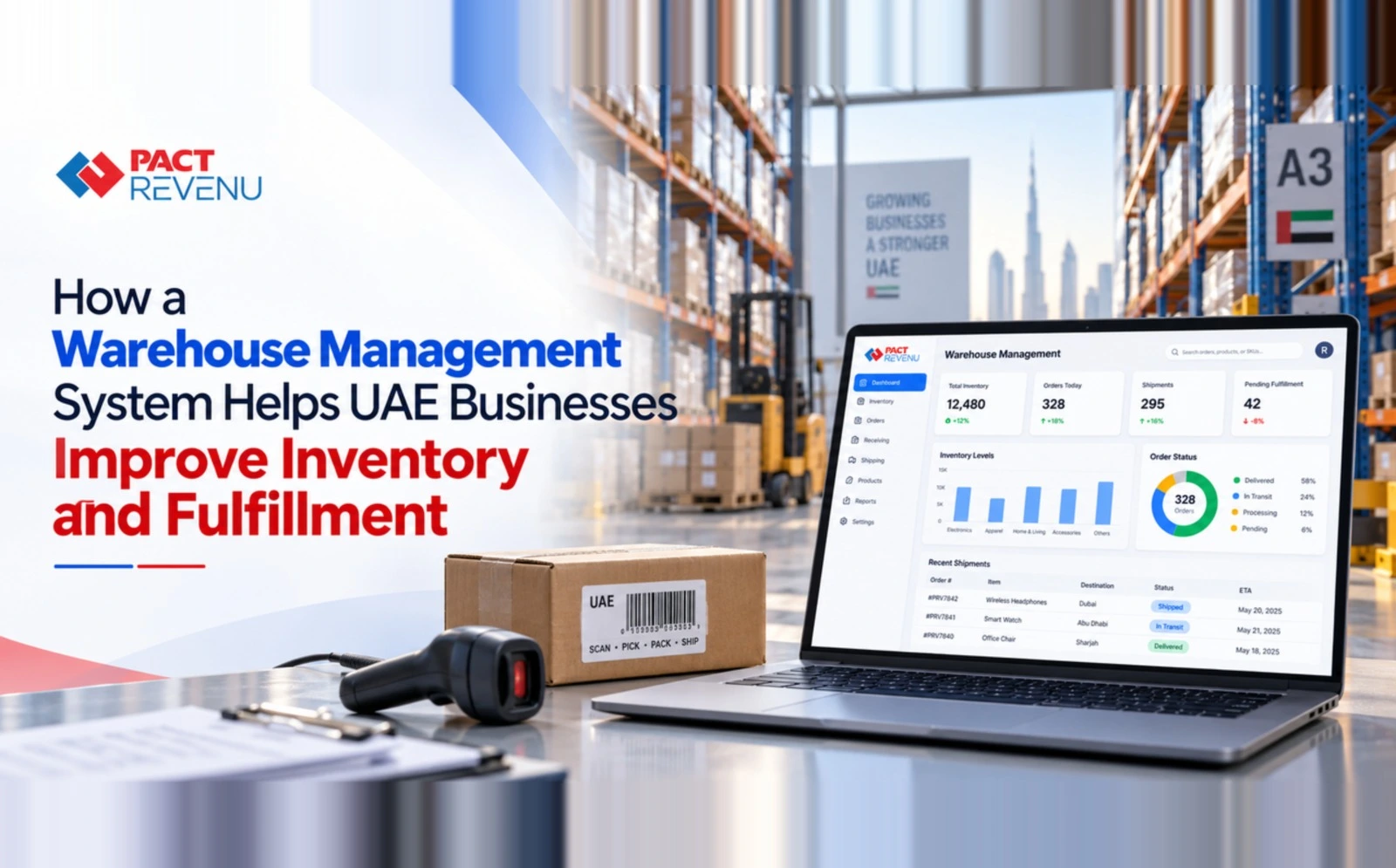
How a Warehouse Management System Helps UAE Businesses Improve Inventory and Fulfillment
For UAE businesses, warehouse operations have become increasingly important to customer satisfaction and business growth. E-commerce companies, retailers, distributors, importers, exporters and businesses serving customers across the GCC often need to manage large volumes of products while keeping inventory accurate and orders moving quickly.
As operations grow, managing stock through spreadsheets, manual records, or disconnected systems can become difficult. Employees may spend too much time locating products, updating inventory, checking orders, or correcting stock discrepancies. These issues can eventually affect fulfillment speed, customer experience and operating costs.
A warehouse management system provides a structured way to manage warehouse activities from receiving goods to storing, picking, packing and dispatching orders. More importantly, it gives businesses better visibility into what is happening inside the warehouse so managers can make informed operational decisions.
What Is a Warehouse Management System?
A warehouse management system (WMS) is software designed to control and coordinate day-to-day warehouse operations. It helps businesses track inventory, organize storage locations, manage stock movements, process orders and monitor fulfillment activities from a centralized platform.
Instead of relying on separate spreadsheets or manual updates, warehouse teams can record and monitor activities through one system.
A typical WMS can support processes such as:
- Goods receiving and verification
- Put-away and storage management
- Real-time inventory tracking
- Stock transfers between locations
- Picking and packing
- Order processing
- Dispatch management
- Stock adjustments
- Inventory reporting
- Warehouse performance monitoring
For a UAE company managing thousands of products or multiple warehouse locations, this level of visibility can make everyday operations much easier to control.
Why UAE Businesses Are Moving Towards Better Warehouse Systems
The UAE is home to businesses operating across retail, e-commerce, wholesale distribution, manufacturing, logistics and international trade. Many companies also serve customers across different emirates and wider GCC markets.
This creates practical warehouse challenges.
An e-commerce business, for example, may need to process a high number of small orders every day. A distributor may need to supply multiple retail outlets. An importer may receive large shipments that must be checked, stored and allocated efficiently.
In each situation, inventory mistakes can create operational problems.
A product may appear available when it is actually out of stock. Employees may spend unnecessary time searching for products. Orders may be picked incorrectly. Stock may remain in one warehouse while another location needs it.
Modern wms systems help businesses address these challenges by connecting inventory and warehouse activities in a more organized workflow.
1. Improve Inventory Accuracy
Inventory accuracy is one of the most important reasons businesses invest in warehouse technology.
When stock is managed manually, discrepancies can occur because of receiving errors, incorrect picking, unrecorded transfers, damaged goods, returns, or simple data-entry mistakes.
A warehouse management system records stock movements as they happen, helping businesses maintain a clearer picture of inventory.
For example, when a shipment arrives, employees can record the received quantities before products are assigned to storage locations. When an order is picked, the stock movement can be reflected in the system.
This creates a traceable flow:
Receiving → Put-away → Storage → Picking → Packing → Dispatch
Better inventory records allow managers to identify discrepancies earlier rather than discovering them only when a customer places an order.
2. Get Better Visibility Across Warehouses
Managing inventory becomes more complicated when a company operates more than one warehouse.
A UAE business may have inventory stored in different emirates or maintain separate locations for different product categories, customers, or distribution requirements.
Without centralized visibility, employees may need to contact different teams to determine where a product is available.
Modern warehouse systems can provide a consolidated view of inventory across supported locations.
Managers can potentially see:
- Available stock
- Reserved stock
- Incoming inventory
- Stock by warehouse
- Stock movements
- Product locations
- Order status
This can help businesses make better decisions about replenishment, transfers and order allocation.
3. Make Order Fulfillment More Efficient
Customers increasingly expect businesses to process and deliver orders quickly. For UAE e-commerce and retail companies, fulfillment efficiency can directly influence the customer experience.
A warehouse management system can organize the picking process by providing warehouse staff with clearer instructions about which products need to be collected and where they are stored.
Instead of manually searching shelves, employees can follow system-driven picking workflows.
Depending on the business setup, the system can support different approaches, including:
- Single-order picking
- Batch picking
- Zone-based picking
- Priority-based order processing
The right approach depends on order volumes, warehouse layout, product types and operational requirements.
The objective is simple: reduce unnecessary movement and make it easier for employees to pick the correct products.
4. Reduce Picking and Packing Errors
An incorrect item in an order can lead to returns, replacement costs, delivery delays and customer dissatisfaction.
These problems can become more noticeable as product catalogs grow.
For example, imagine a UAE retailer handling hundreds of similar products with different sizes, models, or variations. Relying entirely on memory or handwritten lists makes mistakes more likely.
A WMS can introduce structured picking and verification processes. Product information, quantities, storage locations and order details can be made available to warehouse employees during fulfillment.
This does not eliminate human error completely, but it creates a more controlled process for reducing avoidable mistakes.
5. Organize Receiving and Put-Away
Warehouse efficiency starts when goods arrive.
If incoming products are placed wherever space is available, employees may later struggle to locate them. Poor put-away practices can create unnecessary movement and slow down fulfillment.
A warehouse management system helps establish a more organized approach to receiving and storage.
For example, warehouse teams can record incoming goods and assign them to appropriate locations based on the company’s operational rules.
This becomes especially useful for businesses handling:
- Fast-moving products
- High-value inventory
- Different product categories
- Seasonal stock
- Large inbound shipments
- Multiple storage areas
A structured receiving and put-away process gives warehouse employees a clearer understanding of where products belong.
6. Support Faster and Smarter Stock Decisions
Warehouse managers need more than a list of products. They need information that helps them decide what action to take.
A WMS can provide operational data that helps businesses understand stock movement and warehouse activity.
Managers may use this information to identify:
- Fast-moving products
- Slow-moving inventory
- Frequently picked products
- Stock shortages
- Overstock situations
- Warehouse-level inventory differences
- Order processing bottlenecks
This information can support better purchasing, replenishment, storage and workforce decisions.
For a growing UAE business, having reliable operational information can be more valuable than simply having more inventory.
7. Help Businesses Scale Their Warehouse Operations
A warehouse that works well with 500 orders per month may not work equally well when order volumes increase significantly.
Growth often introduces additional complexity. There may be more products, more employees, more storage locations, more orders and more customer expectations.
This is where scalable warehouse systems become valuable.
Instead of redesigning the entire warehouse process whenever the business expands, companies can use technology to create more structured workflows.
For example, a business can gradually introduce:
- Centralized inventory tracking
- Standardized receiving processes
- Organized storage locations
- System-based picking
- Packing verification
- Dispatch tracking
- Warehouse performance reporting
The exact implementation should depend on the company’s size, processes, product categories and future growth plans.
Warehouse Management Software for UAE E-Commerce and Retail
E-commerce businesses have particularly strong reasons to improve warehouse operations.
Online customers generally do not see what happens inside a warehouse. They simply expect the product they ordered to be available, correctly packed and delivered within the promised timeframe.
That means warehouse performance directly supports the customer experience.
Consider an online retailer with multiple product categories and orders arriving throughout the day. If inventory is not updated properly, the company may accept an order for a product that is unavailable.
With better warehouse management software, inventory and fulfillment processes can be connected more systematically.
For UAE businesses competing in a fast moving digital market, this can help create a more dependable operational foundation.
What Should UAE Businesses Consider When Choosing a WMS?
Choosing a WMS should not be based simply on the number of features listed by a software provider.
The better question is:
Does the system solve the actual warehouse problems the business is experiencing?
Before selecting a solution, businesses should evaluate:
Business Requirements
Understand the current warehouse workflow first. Identify where errors, delays and manual work occur.
Inventory Complexity
Consider the number of SKUs, product variations, warehouses, storage locations and stock movements.
Integration Requirements
Check whether the WMS can work effectively with existing ERP, accounting, e-commerce, sales, purchasing, or order management systems where required.
Scalability
The system should support the company’s expected growth rather than being suitable only for its current warehouse size.
Reporting and Visibility
Look for practical reporting that helps managers understand inventory, orders, stock movements and warehouse performance.
User Adoption
Even a technically capable system will have limited value if warehouse employees find it difficult to use. Usability and training should therefore be part of the evaluation.
WMS vs. Basic Warehouse Tracking
Basic inventory tracking may tell a business how many units it has. A more complete wms warehouse management system is designed to help manage how those units move through the warehouse.
That distinction matters.
Inventory tracking focuses mainly on stock records, while warehouse management can cover the operational workflow around that stock.
For a growing company, this means the software can become part of the warehouse process rather than simply acting as another database.
Some businesses may also encounter the term management warehouse system or WMS warehouse system when researching solutions online. Regardless of the terminology used, businesses should focus on the actual capabilities of the platform rather than the label.
The Business Impact Goes Beyond Inventory
The value of a warehouse management system is not limited to knowing how many products are available.
Better warehouse processes can influence several areas of the business.
When inventory information is more reliable, purchasing teams can make better replenishment decisions. When picking is more organized, fulfillment teams can process orders more consistently. When warehouse managers have better visibility, operational bottlenecks can be identified earlier.
This creates a connected operational cycle:
Better inventory visibility → Better warehouse decisions → More organized fulfillment → Better customer experience
The technology itself is only one part of the equation. Businesses also need clear processes, trained employees, accurate product information and disciplined warehouse practices.
Conclusion
For UAE businesses, warehouse efficiency is closely connected to inventory control, fulfillment performance and customer satisfaction. As companies expand across e-commerce, retail, distribution and GCC markets, manual warehouse processes can become increasingly difficult to manage.
A warehouse management system provides a structured way to control inventory and warehouse activities while giving decision makers better operational visibility.
The right solution should not simply add technology to an existing warehouse. It should help the business create clearer processes, reduce avoidable operational issues, support growth and make better decisions based on reliable warehouse information.
Frequently Asked Questions
What is a warehouse management system?
A warehouse management system is software that helps businesses manage warehouse operations such as receiving, storage, inventory tracking, picking, packing, stock movement and dispatch.
How does a warehouse management system improve inventory accuracy?
It records inventory movements through structured warehouse workflows, helping businesses maintain more consistent stock records and identify discrepancies earlier.
How can WMS improve order fulfillment?
A WMS can organize picking, packing and dispatch workflows, helping warehouse employees locate products efficiently and process orders in a more controlled manner.
Why do UAE businesses need warehouse management software?
UAE businesses managing e-commerce orders, retail distribution, imports, exports, or multiple warehouse locations can benefit from better inventory visibility, organized warehouse processes and improved fulfillment control.
What should businesses consider when choosing a WMS?
Businesses should evaluate warehouse requirements, inventory complexity, integrations, scalability, reporting, usability, implementation needs and whether the system solves their actual operational challenges.